
Batavia Township Address History by Era
A backward address trail needs a source that fits the period in question. The Recorder’s online images show recorded land documents from 1980 forward. The older archive still exists, but the official web source does not state its oldest indexed year, so a researcher should use a defined party name, legal description, book/page, or document lead at the counter or in a written request. The Batavia Branch and Clermont County Genealogical Society add newspaper, map, census, obituary, cemetery, and family-file routes that a deed index does not supply.
| Trail source | Verified period | Where it is reached | What it can show |
|---|---|---|---|
| Recorder online document images | 1980 to present | CountyFusion through Recorder instructions | Recorded land instruments and title links, not a household roster. |
| Recorder archive | Earlier material exists; oldest indexed year not verified | Recorder counter or written request | Older deeds and record books when a party or legal description is supplied. |
| CCGS and CCPL newspaper microfilm | 1814 to present | Batavia Branch, in-library | Notices, obituaries, local events, and address-area clues. |
| CCGS 1930 census index | 1930 | CCGS index and microfilm path | A household snapshot after the correct Township or Village area is identified. |
| Historic owner maps | 1870 and 1891 | CCGS member resource | Rural owner and map context, subject to date and area interpretation. |
| Batavia Sanborn map | 1885 | Library of Congress digital item | Structure and street context in the mapped Batavia area, not all Township land. |
A records trail often changes source types before it changes names. Preserve the date and exact form of each address, parcel, legal description, postal label, and Township or Village reference before moving to the next era.
Batavia Township Parcels Start the Past
The present parcel is the safest launch point for a past-resident inquiry. Search the physical address in the Clermont Auditor address mode, save the parcel ID, owner spelling, Full Address or situs, mailing field if visible, legal-description clues, and last-sale cue. Then locate the parcel in Clermont GIS. Check road spelling, nearby parcels, the Township or Village line, ZIP and precinct layers, and the subdivision or lot geometry. A numbered address can belong to a nearby structure or multi-unit site, so the map is a useful check before a name is carried backward.
The order is simple: address to parcel, parcel to map and legal description, legal description to recorded document, and recorded party to prior document. A current owner can receive mail elsewhere, and a person connected with a historic household can be absent from a deed. The record should be labeled for what it proves rather than stretched into a conclusion about everyone who lived there.
Note: A Batavia postal label does not establish Township or Village jurisdiction; compare the parcel to county GIS before requesting local zoning or permit material.
Batavia Township Deed Records Backward
Recorded deeds form the backbone of the past-resident address trail, but they document title transactions rather than every household move. Once the Auditor and GIS records point to the same parcel, search the current owner in CountyFusion. Clermont Recorder guidance says a name-only search is generally the most complete and that less input can return more variants. Identify the acquisition deed by its document type, recording date, and legal-description text. Then carry the former owner back as a possible earlier grantee, checking the legal description at every transfer.
- Record the parcel ID, legal-description clues, current owner, and source date from the Auditor property result.
- Search the current owner in CountyFusion and isolate the acquisition deed from the returned documents.
- Match the deed description to the parcel, lot, survey, or subdivision rather than relying only on the street wording.
- Read the prior owner in the grantor field, then search that name as a possible earlier grantee.
- Repeat the title sequence backward and mark the point where the online image path ends.
- Grantor
- The party conveying an interest in a recorded instrument. In an acquisition deed, this is usually the preceding title holder.
- Grantee
- The party receiving an interest. Searching an earlier grantor as a grantee can locate that person’s own purchase.
- Chain of title
- The documented sequence of land transfers for the same parcel. It tracks title, not the complete set of people present there.
- Legal description
- The deed’s lot, block, subdivision, survey, acreage, or metes-and-bounds identifier. It is more stable than a road label across time.
Start through the Clermont CountyFusion entry, then use the Recorder instructions if the public/guest routing or disclaimer screen appears.
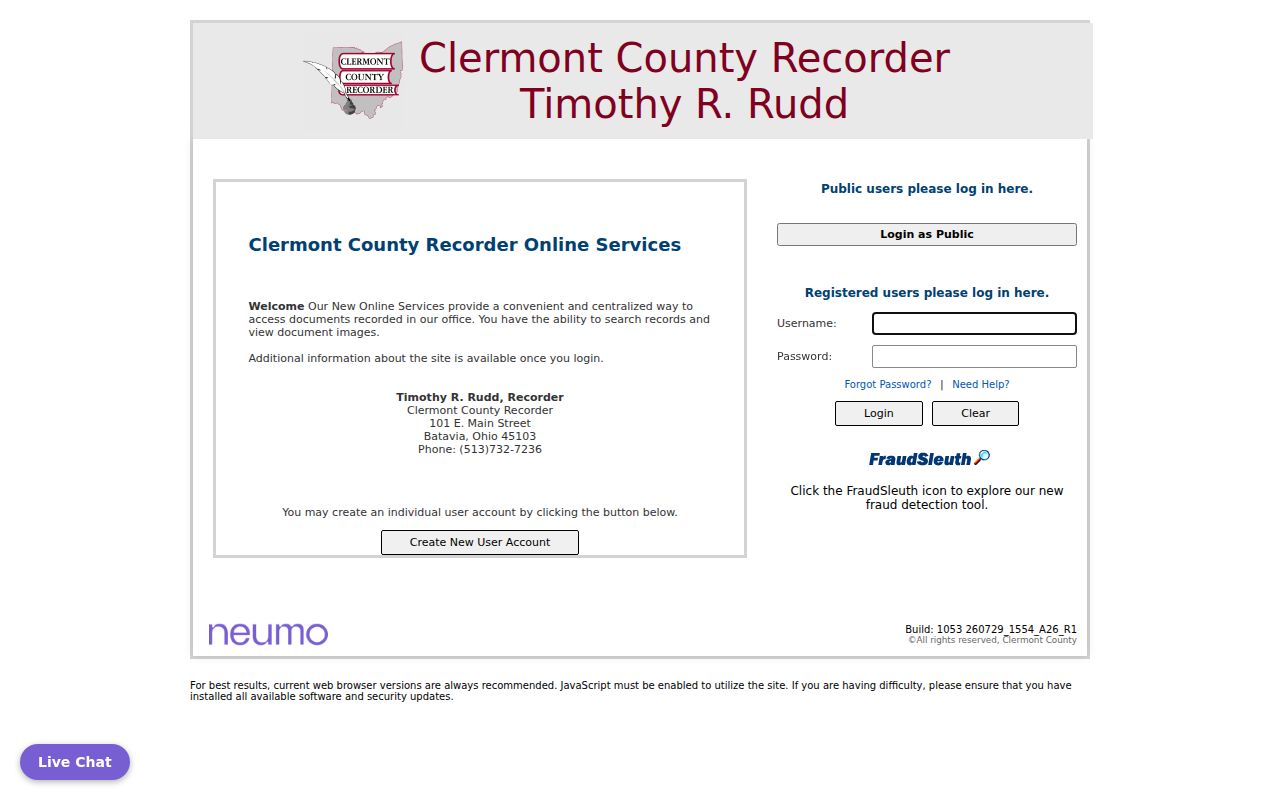
The Recorder route shows why party names and legal descriptions, rather than a street-only query, carry the title sequence backward.
Batavia Township Records Beyond 1980
The Recorder’s public website makes document images recorded from 1980 to the present available online. That is an online-access boundary, not the beginning of the Clermont land archive. When the chain reaches an earlier transfer or an index gap, move to the Recorder’s counter, mail request, and staff-guided historical path. The counter is at 101 E. Main Street in Batavia, open 8:00 a.m. to 4:30 p.m. The office accepts focused public-record requests, and its form is encouraged but not mandatory. Give staff a party, legal description, book/page, document number, or useful date range instead of requesting all records for a house.
The access choices are distinct. In-person computer prints cost 10 cents per page, a book pull costs 25 cents per page, and mail copies cost $2.00 per page. A mail request requires the fee and a self-addressed stamped envelope. The Recorder can require advance payment and postage. The office phone is 513-732-7236, fax is 513-732-7891, and email is recorder@clermontcountyohio.gov. Records Management can help identify stored historical series, but the office of origin controls release authority.
Review the Recorder FAQ and copy options before choosing the online, counter, or mail path.
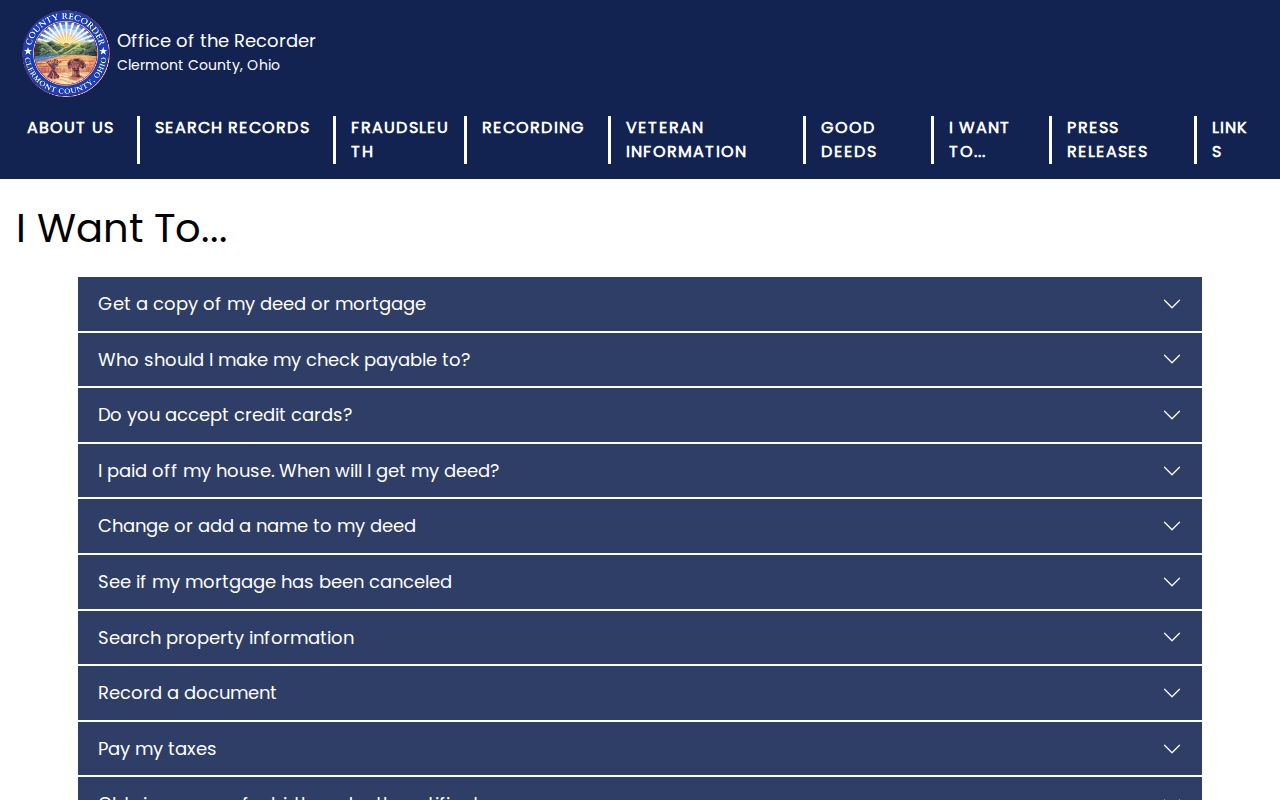
The Recorder’s published access information makes the web cutoff a cue to switch channels, not a reason to stop the history search.
Batavia Township Past Households in Census
Deeds identify a title trail. To test who lived in the area during a period, pair it with the local directory, newspaper, census, and map evidence that matches that year. No confirmed continuous reverse or criss-cross directory run was found for Batavia Township, so an address should not be treated as if it can be browsed year after year in one local volume. The confirmed 1882, 1896, 1902, and 1932 Clermont titles are separate holdings, not a continuous annual series. The 1896 Thirey and Mitchell item is a rural county directory with township, post-office, land, and biographical fields, not a modern numbered-address directory.
- Keep the Township, Village, post-office, road, and legal-description wording found in the title record.
- Search CCGS and Batavia Branch catalog fields such as Place, Title, Surname, and Description for the relevant area and name variant.
- Check the 1930 local index with the correct geographic code: BA for Batavia Township and BVL for the Village of Batavia.
- For Township outside the Village, use the cited 1930 roll 1757 pages 170 through 187 as the local index points to the census material.
- Compare the period source with newspapers, probate, obituary, map, and deed evidence before assigning a household to the parcel.
The Doris Wood Batavia Branch houses the CCGS collection for in-library use. It has the Genealogy Collection, public computers, copying, scanning, fax service, and a microfilm reader-printer. The library is at 180 S. Third Street, Batavia, and phone is 513-732-2128. CCGS materials include surname notebooks and files, obituary cards, county-record guides, and maps. The historical directory collections are described in more detail on the Batavia Township city directory page.
Open the CCGS records and indexes collection for its locally documented genealogy paths.
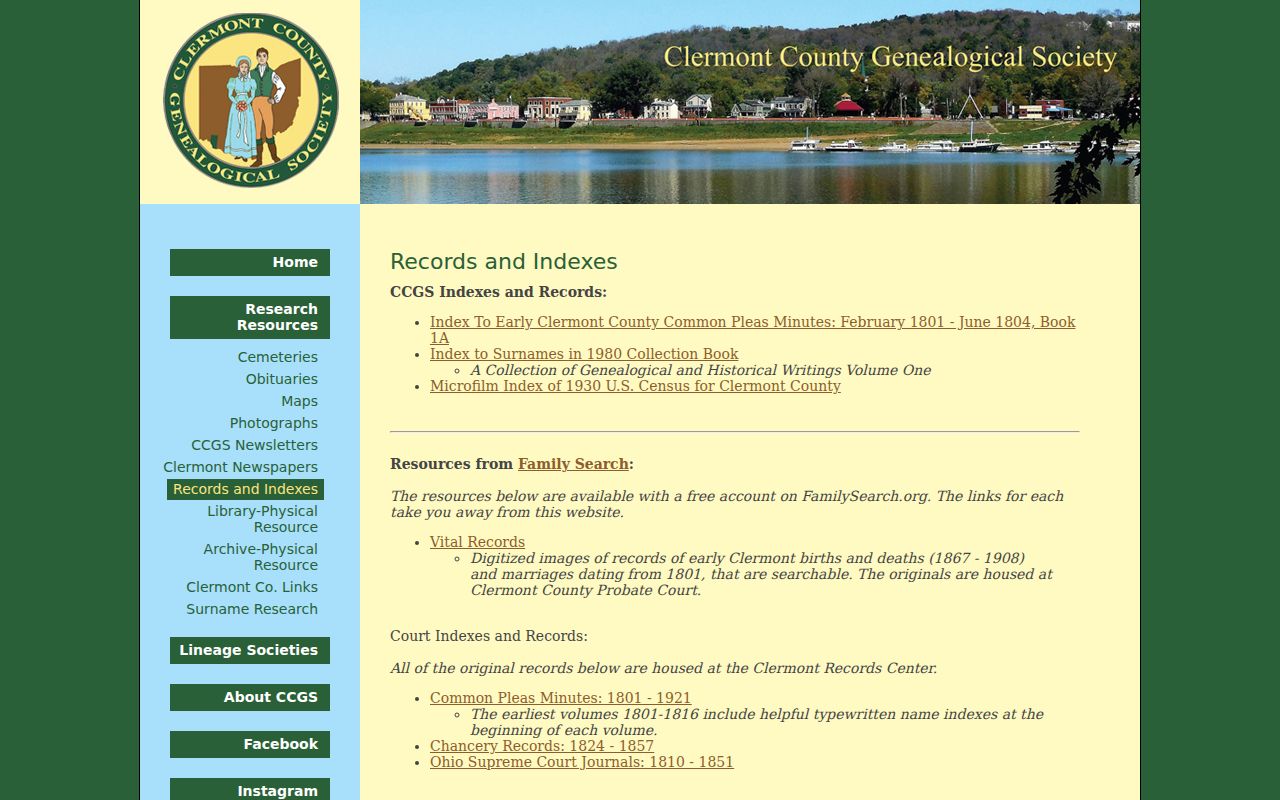
The CCGS path adds period-specific evidence when the title chain alone cannot identify a past household.
Batavia Township Past Resident Notices
Newspapers, obituaries, cemetery entries, and Probate material can close or refine a trail when a former title holder dies, transfers an estate, or leaves the area. CCGS reports Clermont County newspapers on microfilm from 1814 to the present at the Batavia library. Its newspaper guide identifies digital paths for the Clermont Courier beginning in 1836 and the Clermont Sun beginning in 1852 through the Cincinnati library route, while the in-library microfilm remains a local alternative. Search a name with the community and period, then treat an obituary or notice as a lead to the relevant original vital or Probate record.
The CCGS obituary database has surname and given-name fields, and its interface asks searchers to enter one or more letters to stay below its result threshold. It is a research index, not an official certificate. CCGS reported more than 30,000 obituary records and 45,440 burials from 201 Clermont cemeteries in its 2026 materials. Probate is the county custodian for marriage licenses, estates, wills, guardianships, and certain historical vital questions. For a pre-1908 Clermont birth or death question, the county Records Management guidance directs researchers to Probate Court.
Note: A notice, cemetery entry, or obituary can support a date and family lead, but it does not by itself prove that an address was the person’s legal or current residence.
Batavia Township Property Records on Roads
Historic property research needs an address continuity check. CCGS offers 1870 and 1891 Clermont Township owner maps as a member resource. The Library of Congress provides an 1885 Batavia Sanborn map, but it covers the mapped Batavia settlement area rather than all rural Township acreage. Use a historic map to place a property in its period context, then compare that setting to the plat, legal description, parcel geometry, and recorded road material. Modern numbers and postal names should not be pushed backward without those checks.
The Recorder’s inventory includes plats, annexations, centerline surveys, street-name changes, and street or alley vacations. These are the right record types to request when an old road name conflicts with a current street label. Township history notes that Donnells Trace is present Old SR 74 or 32. It supplies a route-history lead, not a blanket match for every property. No authoritative source verified a Township-wide street renumbering project, so the safer test is the legal description plus dated maps and records.
Batavia Township Records Center History
Clermont County’s Records Management Division preserves a useful bridge across the pre-web gap. The center began operating in 1998, moved in 2005, and opened its purpose-built climate-controlled facility in 2019. It reports 6,500 historical journals and plat books, 10,000 paper-record boxes, and nearly half a million electronic records. The scale explains why an empty online search is not the end of a Batavia Township previous-residents inquiry.
The center keeps material for more than 40 county offices, but it does not have release authority. Start with the Recorder, Probate Court, Clerk, Auditor, Township office, or other source office that created the needed record. That provenance rule helps a request reach the custodian who can explain access, copies, redactions, and whether a historical series is held in storage or still at the office.
Batavia Township Past Residents and Privacy
House-history research should stay focused on records and eras, not on tracking living people. Ohio Safe at Home participants have confidential identifying information under ORC 111.41 through 111.47, and confidential voter records are omitted from public statewide versions. ORC 149.45 offers a precise route for an individual to ask an office to redact certain personal information from a web record. It is not a broad right to erase a lawful recorded land instrument, court entry, or parcel-history fact. The Recorder states that it cannot alter, redact, or delete a recorded document except where Chapter 317 or another law permits it.
Lawful use. Use a Batavia Township address history for family history, estate research, property context, and personal curiosity. Never use a record trail to stalk, threaten, harass, or harm any person.
Use the Recorder public-records policy when a defined record request or a question about official redaction is needed.
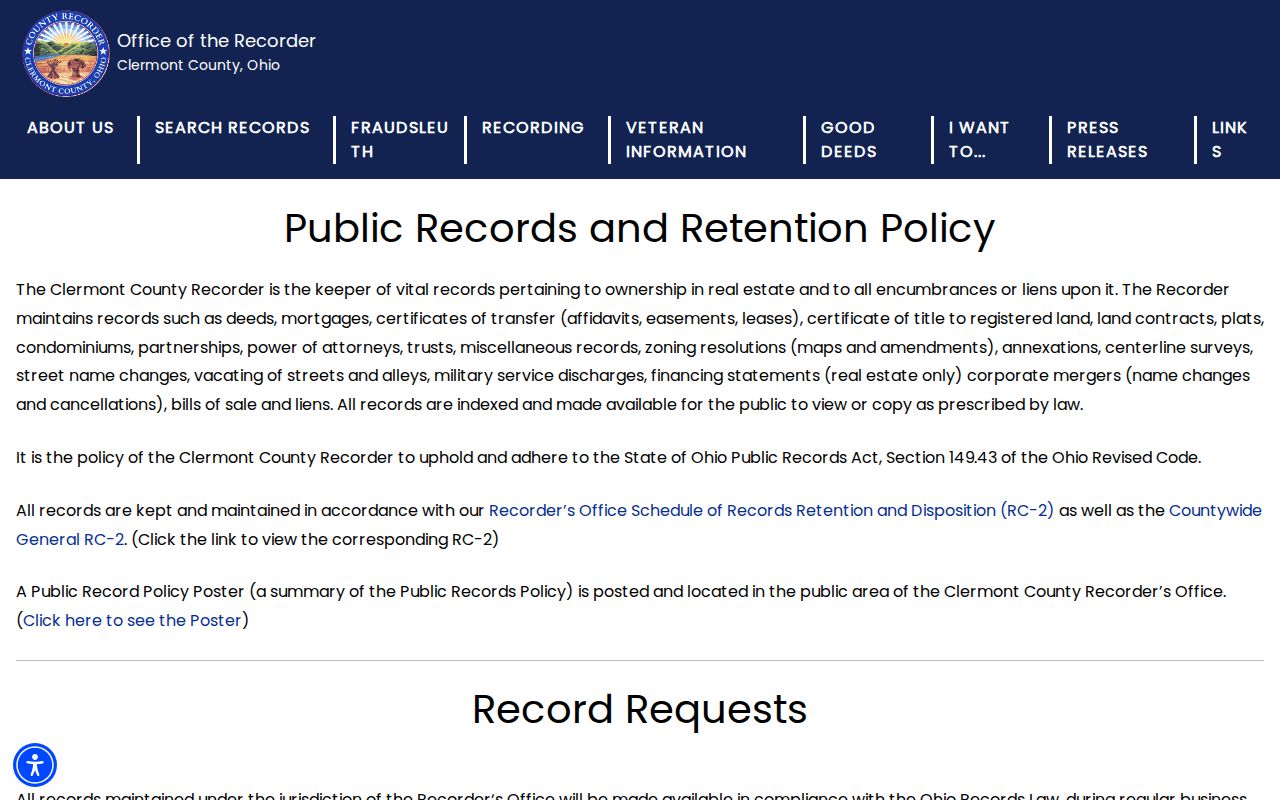
The policy reinforces the practical rule: ask for an identifiable record and contact the office that controls it for a response or statutory explanation.
For counter hours, contact information, and a copy route, consult the Clermont County Recorder contact page.
The Recorder counter is the documented local fallback when an older deed, book record, or copy cannot be reached through the online image search.